The Connoisseur’s Responsibility
March 4th, 2024 | Abdulsamad Sulyman
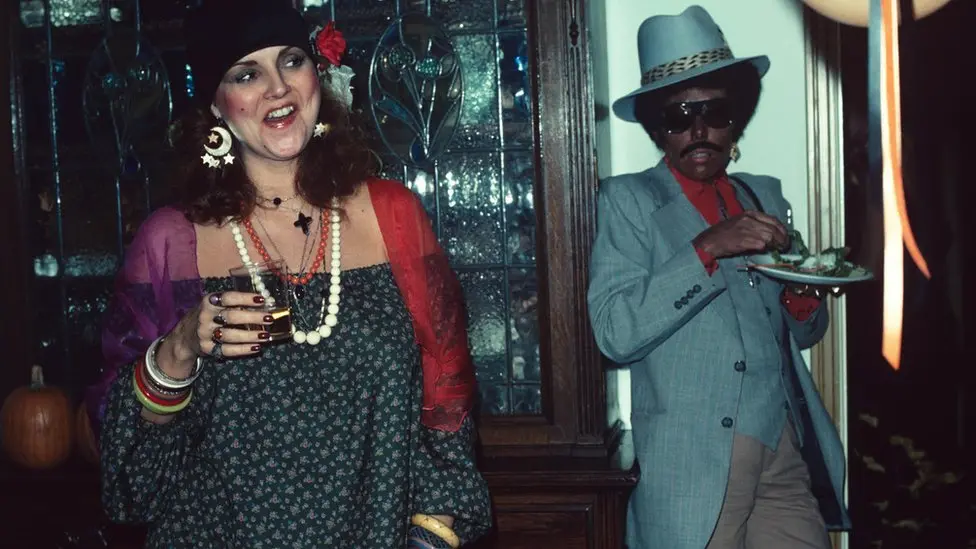
Fig. 1. Joni Mitchell (rear) and a friend at Leland Sklar houseparty, 1976
Step back into the spooky scene of 1976, where the legendary session maestro Leland Sklar, transforms his Los Angeles residence into a haunted haven for a Halloween bash like no other. Amongst the flickering candlelight and eerie decorations, gather the titans of the music industry. Picture the likes of famed producer Peter Asher and drummer Russ Kunkel, summoned by Sklar's invitation to join in a night of celebration.
Standing quietly in the back of the main room is a black man in a turquoise suit jacket and vest, wearing a complementary green-blue fedora and a pair of jet black aviators. A wide, bushy mustache and prodigious afro define his features, and his presence at the party is inexplicable. Nobody seems to know who he is, and he is collectively regarded as someone else’s friend. When the mystery of his identity becomes too much to bear, host Leland Sklar approaches him, and asks if he is at the right party. The response comes not from a pimp-like figure as expected, but instead from singer Joni Mitchell, sporting blackface and obscure outfitting, intended to imitate her own take on black culture.
Joni Mitchell is renowned for her control of her vocal ranges, and her ability to use her volumes to speak to deep emotion. Her fans proclaim her music has the ability to mobilize emotion in a way very few other musicians can, and that her lyricism in and of itself is transformative. What her fans seem to forget, however, is the grim history that exists regarding her interactions with and opinions of black culture, black identity, and black experiences.
Zadie Smith is one of these fans in her essay Some Notes on Attunement. In the essay, Smith lectures on Joni’s power as a musician, and begins her discussion in an immediate spirit of reflection, listing the assortment of different artists that defined her early life, and explaining the absence of specific kinds of musicians. The likes of “Luther Vandross, Chaka Khan, The Beatles” (1) and many other mainstream artists were the kind her family would listen to — with the exception of white women. Listening to artists that aligned with a “natural demographic within the house” (1) was crucial to Smith’s family, and besides, “What did [The Smiths] need with white women?” (2)
Following this quick expository, we jump immediately into another memory of Zadie Smith’s. Here, we come to learn that initially, Joni Mitchell was not an exception to the absence of white female musicians in Smith’s life, and that Smith was even pressured to listen to the artist. Friends and family would react with snobbish pity upon hearing about Zadie’s lack of relationship with Joni’s music, often patronizing her for her lack of taste. As we keep reading, Zadie continues contextualizing her first introductions to Joni’s music.
All throughout her essay, Zadie communicates by rapidly shifting between memory and meditation, almost like an unorganized memoir. She speaks of her journey to the Tintern Abbey, drawing a contrast between her relationship with Joni Mitchell, and with William Wordsworth’s relationship with nature. Her nonlinear narrative structure reflects the nonlinear nature of memory itself, where associations and connections between past experiences and present emotions are not always chronological or orderly. Discussions about music naturally unfold in a scattered, episodic manner, mirroring the complex and multifaceted ways in which music shapes our lives and memories.
We emerge from the discussion of the Tintern Abbey understanding that a profound change occurred somewhere in the life of Zadie Smith, unlocking her receptivity to the music of Joni Mitchell. Once a harsh opponent to Joni Mitchell’s music, there was now a “structural difference” (5) between present Zadie Smith and the version of Smith that “hated [Joni] so completely” (5). Now, Zadie was overcome with “uncontrollable tears” caused by a “recognition of an almost intolerable beauty” (5) in Joni’s music, engulfed by the “same feeling the artist had while creating [these songs]”. Through Zadie’s narration, we learn of the transformation of listening invoked in Smith by Joni Mitchell’s music.
It is collectively understood that music can be revolutionary, and Zadie has made a clear point to discuss the power of Joni’s music in particular, and its ability to appeal to different emotions a person experiences. But in her proclamation, and in her selection of what to discuss, we readers come to grapple with a critical interpretive problem.
In her discussion of connoisseurism, the ability to “stoop to consider the supposed lowliest examples of [a] form while simultaneously rising to admire the obscure and the esoteric” (6), Zadie unknowingly admits to a major fallacy regarding her interactions with Joni Mitchell’s music. Shortly after defining the term connoisseur, Smith states that she “didn’t come to love Joni Mitchell by knowing anything more about her”(6), and that instead, she “hated Joni Mitchell—and then [she] loved her” (6). She asserts “it’s not even really the content of the music that interests” (6) her, and clearly defines her welcoming of Joni Mitchell’s music as not a “progressive change in taste” (6). Then, Zadie brings into question what forces motivated such a “paradigm shift in [her] ability to listen to Joni Mitchell” (6), and halfheartedly suggests ignorance to be a condition for this change.
Ignorant is exactly how an informed reader would define Zadie Smith’s discussion of Joni Mitchell. All throughout the first paragraph, Smith makes a conscious effort to define the music of specifically white women as unfulfilling of her needs. She explicitly states her family needing “songs that made [them] dance, laugh, or cry”(1), a need white women could not adequately cater to. Then, in her lengthy discussion of Joni Mitchell’s music, we segregate Joni as an exemplar, an exception to the silent rule of Zadie Smith’s music collection. But what value does Zadie’s discussion hold considering the nature of Joni Mitchell’s actions in the past? Does the pedestal of greatness Zadie works so hard to place Joni Mitchell on dissolve when the reader realizes that Zadie Smith never took into consideration Joni’s values as a person? Does Zadie’s ignorance destroy the reputability of her essay?
This is where a crucial discussion of what it means to be a connoisseur, a critic, and a fan comes into play. Fans hold the responsibility of being the first person or group to hold an artist accountable. To be a fan means to know an artist on a deeper level, knowing their background, their interests, their relationships, and their opinions in a manner of detail that sets you apart from general consumers. Accordingly, with all that knowledge comes the expectation that fans will hold their artists accountable. To be a fan means to be both a critic and a connoisseur. Zadie Smith, for the bulk of her essay, is only the latter.
Acknowledging this truth, Zadies states “we want our artists to remain as they were when we first loved them”(13). This mentality, the willing choice to bypass better judgment to preserve feelings like nostalgia and validation from an artist, is a choice Hanif Abdurraqib makes a clear point of critiquing in How to Be Critical of Things You Love, an article about a fan’s responsibility.
The article opens with Abdurraqib stating “‘Fans have to have an ability to be wrong...To not understand, and be comfortable not understanding.’” (Arjini 1). Continuing to read, we witness as the interview begins to dive into the nuanced relationship between fans, artists, and understanding, eventually transitioning into a crucial theme embodied by Zadie’s essay: “how and why we love artists, and what we can do with that love” (Arjini 1).
In reading both How to Be Critical of Things You Love and Some Notes on Attunement , the clashing differences between Abdurraqib’s definition of the responsibility of fans and Zadie Smith’s position far outside this description become glaringly evident. In How to Be Critical of Things You Love, Abdurraqib states: “‘ What people are actually asking for is absolution for the things they love…the political responsibility of the fan is to challenge [memory]—challenge the desire for nostalgia and, in doing that, challenge the soundtracks that have latched onto this nostalgia. ’” (Arjini 1). This statement, a head-on attack at the question of a fan’s responsibility, is in striking conflict with how Zadie Smith connects with the music of Joni Mitchell. Zadie refuses to acknowledge the troubling past of Joni Mitchell in any of her descriptions, at the exception of the very end of her essay. The largest majority of Zadie Smith’s discussion of Joni is neglectful: neglectful of the blackface Joni wore, neglectful of Joni Mitchell’s unearthly obsession with black culture, and neglectful of the implications of idolizing a racially problematic artist as a person of color.
It was here that I took a step back from both texts, and began to wrangle with the ideas of absolution, accountability, and critique. Again I asked, what value does Zadie’s praise of Joni Mitchell hold when it juxtaposes, so strongly, the concepts of accountability and objective critique? A fan as devout as Zadie, by her own definitions, can be regarded as a connoisseur of Joni’s music. Is this definition fitting, is it right to regard Zadie as a connoisseur, when she contradicts so strongly the example of political responsibility in fans defined by Hanif Abdurraqib? How do we navigate the complexities inherent in both art and artist? Can we reconcile admiration for an artist's talent with condemnation of their problematic behavior?
In search of answers to these questions, I took back to Hanif Abdurraqib’s interview. Answering the question of what accountability in fans looks like, Abdurraqib introduces the example of Kanye West, an artist often defined by controversies surrounding his behavior and statements. Initially, Abdurraqib acknowledges and even validates the virtuosity of Kanye West: “‘ he’s already earned being a genius, and…he once moved the culture forward’”(Arjini 1). Immediately after, however, Abdurraqib denounces the pedestal of idolization that is often created for artists like Kanye West, the same pedestal that Zadie Smith creates for Joni Mitchell. In discussing this pedestal and Kanye West, Abdurraqib states “It’s not accurate, and it’s not fair to…his evolution as an artist. It’s not fair to anyone to not have an accountability structure’” (Arjini 1). He calls out fans who threaten the accountability structure for artists, defining them as “‘people who are delusionally following the cult of personality’”(Arjini 1).
It is tempting to lump Zadie Smith into this category of fans, considering how much she praises Joni, and how little she says about Mitchell’s character and morals. The only mention of Joni Mitchell’s sordid character is in a short section at the end of Zadie’s essay, long after extensive praise: “I didn’t know anything about her “black period” until I started to write this piece and read some of her interviews online, among them a discussion she with a Texas DJ in 1998” (14). In giving Zadie the benefit of the doubt, it could be argued that she did not know about Joni’s behavior early enough to address it in Some Notes on Attunement, and that her eventual mention of it on the 14th page was adequate. I don’t find this to be the case.
Why does Zadie Smith separate the art from the artist? Is Joni Mitchell’s music that revolutionary, good enough to absolve her of being held accountable? I believe the answer lies more in Zadie than it does Jonie. Zadie Smith is a well-informed, biracial essayist navigating the complex terrain of identity, race, and culture; her choice to (effectively) ignore the complex history of Joni Mitchell’s interaction with Zadie’s own culture must have been intentional. Thus, Zadie, like millions of others, is guilty of absolution of things she loves—in her case ‘things’ being the music of Joni Mitchell. Reading her essay, we must recognize the tension between admiration of artistic brilliance and the responsibility to hold creators accountable, and contend with Zadie Smith’s placement on this spectrum of responsibility.
Works Cited
Smith, Zadie. “A Voyage Around Joni Mitchell.” The New Yorker, The New Yorker, 10 Dec. 2012, www.newyorker.com/magazine/2012/12/17/some-notes-on-attunement.
Arjini, Nawal. “How to Be Critical of the Things You Love.” The Nation, The Nation, 12 Feb. 2019, www.thenation.com/article/archive/hanif-abdurraqib-tribe-called-quest-book-interview/.
“When Joni Mitchell Wore Blackface for Halloween.” BBC News, BBC, 28 Oct. 2016, www.bbc.com/news/magazine-37781800.
Diltz, H. (1976). Fig. 1. Joni Mitchell (rear) and a friend at Leland Sklar houseparty, 1976. https://www.bbc.com/news/magazine-37781800. https://www.bbc.com/news/magazine-37781800